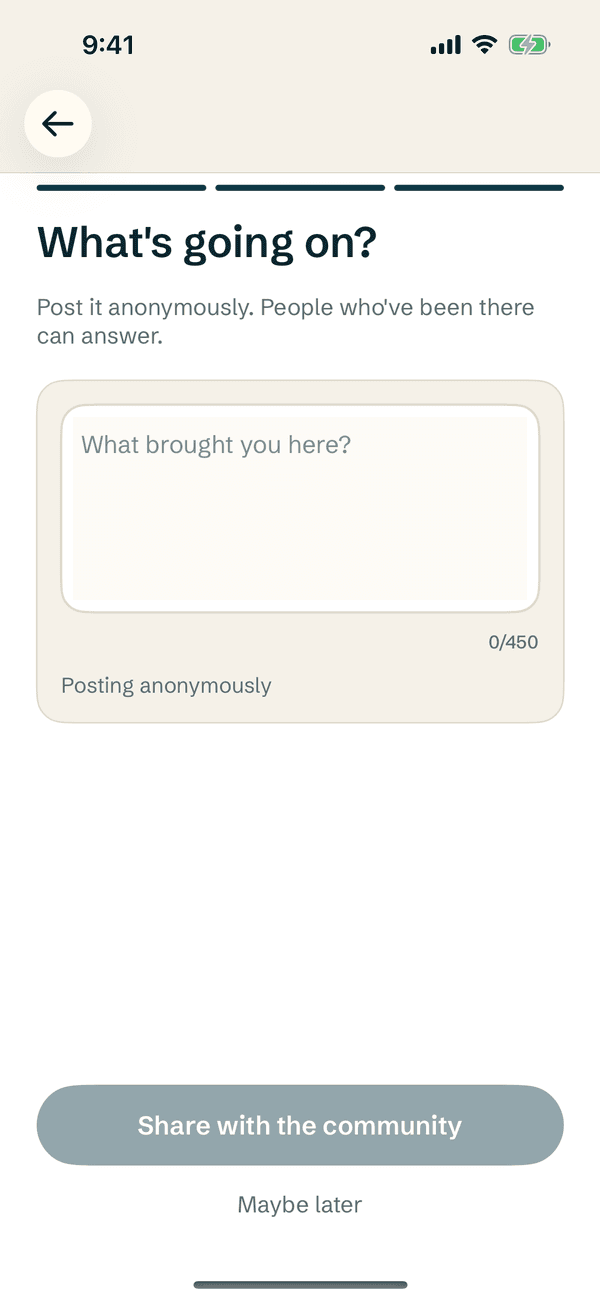
You Don't Have to Face This AlonePost What's Going On. People Who've Been There Can Answer.
Free peer support for depression and anxiety — from people who actually understand. You post under a handle, not your name. Post any hour.

Anonymous to everyone you talk to · Always free
Here's the honest version.
veisund has been on the iPhone App Store since April 2020 and arrived on Google Play in August 2026. The community is small and growing: the Play listing shows 500+ downloads, and that is the honest scale of this thing today. We don't have user testimonials to show you yet, and we're not going to write our own — when real ones exist, a real person will have said them.
What we can show you instead is what the community actually did. Most weeks, a handful of posts draw a handful of replies — the median week over the last three months saw about 5. That is small, and it is the honest number: we briefly published a much bigger one, audited it, found it was one unrepresentative week, and corrected it. What smallness buys you is that your post is one of a few, not one of nine thousand. What actually happens when you post →
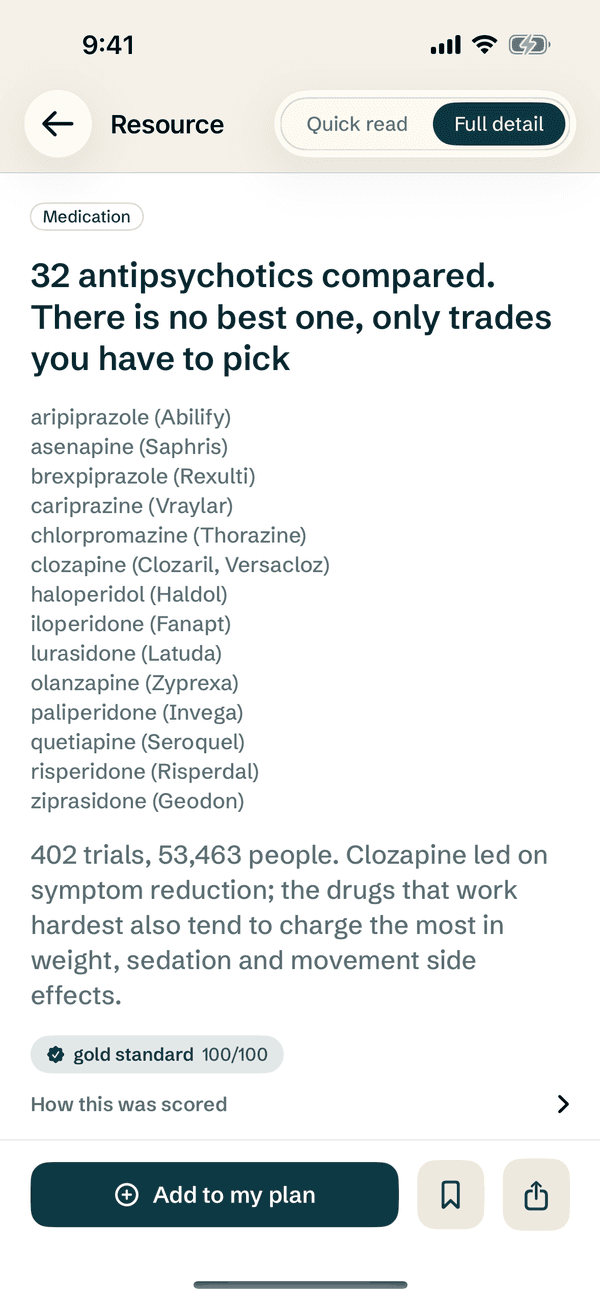
What we can show you is the part we can prove. Every research summary in the app carries a trust score that is calculated from recorded facts about the paper — study design, funding, journal, sample size — not typed in by anyone. A retracted paper scores zero and is blocked from being published at all. As of 19 August 2026, the library held 251 published summaries. All 251 cite a named primary source: 233 cite a DOI, and every one of those DOIs resolves at Crossref; the other 18 cite primary regulatory and clinical documents — FDA safety communications and drug labels, EMA, DailyMed, NICE, the Royal College of Psychiatrists. None cite Wikipedia, a news write-up, a blog or a trade book, and none cite a retracted paper. And none of those links is dead: all 231 distinct citation links were checked on that date and every one resolved. We would not have put that sentence here a week ago, because a publisher can quietly reorganise a URL and falsify it without anyone touching this page — so a check now re-tests every citation in the library on a schedule and goes red the day one breaks.
The number we would rather show you is this one: 195 of the 251 carry a written caveat on their own trust rating. A caveat gets written when the source has a specific weakness worth flagging — an active placebo, a sponsor who supplied the study drug, a Cochrane review that rates its own trials at high risk of bias — so the other 56 are studies where we looked and found nothing to warn you about, not studies nobody checked. It is not only the weak papers, either: 51 of the 72 meta-analyses of randomised trials, the strongest design in the library, carry one. The caveat renders next to the badge every time, because a gold-standard pill on its own is the half that flatters.
You don't have to take our word for any of it, and you don't need the app to check: every summary is free to read on the web, with its source, its trust score and the reasoning behind that score on the page. Browse the evidence library →
The rubric is public, including the parts that don't flatter us. Read how we score evidence →
The library is free to read. No app needed.
What the trials found, what the regulator wrote, and who paid, for the medications people are handed and the supplements they buy instead. Every claim cites a trial, a regulator or a court record. 353 published summaries as of 17 September 2026.
37 medications, A to Z
The FDA approval journey with label quotes, the safety signals with their caveats, and who pays for the prescriptions.
17 supplements and unapproved substances
Ashwagandha to zinc. What the trials actually found, and how thin the evidence is when it is thin.
12 legal and safety records
Court settlements, FDA warnings and label changes for the most prescribed psychiatric drugs, dated and sourced.
Follow the money
Who pays for the FDA, the associations that write the manual and own the billing codes, the questionnaire Pfizer paid for, and where the drug money goes.
The system, counted
How many people have a mental illness, how many take medication, who ends up in hospital, and what a stay costs. Federal numbers with their limits printed above them.
353 research summaries
The library inside the app, readable on the web: each summary with its source, its trust score, its caveat, and a plain-language version.
Also free to read: free sites and apps like 7 Cups · Lexapro vs Zoloft · Wellbutrin vs Lexapro · is it ok to use ChatGPT as a therapist? · free therapy without insurance · do you qualify for sliding-scale therapy? · claims we checked
explore
- medication explainers — what the boxed warning means, what the approval rested on, who pays, for 37 psychiatric drugs.
- supplements and unapproved substances — ashwagandha to zinc: the regulatory paragraph first, then every study.
- comparisons — sertraline vs escitalopram and 32 other pairs, on the public record, never ranked.
- alternatives — betterhelp, 7 cups, talkspace and the rest, priced from their own sites.
- topics — does it work, the legal records, the system counted, who funds what.
- checked claims — things said on podcasts and youtube, taken to the primary record, both directions.
- minnesota, city by city — crisis links, the state’s own numbers and local prescribing for 42 cities.
- free therapy — every real route to free or low-cost therapy in the US, with the catch on each.
- the book series — sixteen widely read mental-health books, each central claim checked against the record.
How it works
Share under a handle
Post about what you're going through under a handle you pick. No real name, no phone number — nobody there sees anything else.
Get real support
Connect with people who've been through similar experiences. Real conversations, not chatbot scripts.
Find resolution
Mark your journey as resolved when you're ready. Celebrate progress, not just pain.
Library figures from an internal audit of every published resource on 19 August 2026: 251 summaries; 251 of 251 cite a named primary source; 233 cite a DOI and all 233 resolve at Crossref; the remaining 18 cite FDA (10), EMA (2), DailyMed (2), NICE, the Royal College of Psychiatrists, gov.uk and PubMed; zero cite Wikipedia, news articles, blogs or trade books; zero retracted papers cited; 195 carry a written caveat on their trust rating. Zero dead citation links: on 19 August 2026 all 231 distinct links were tested — 214 DOIs verified as registered at Crossref, 17 regulator and PubMed pages fetched — and none was dead. That last one is not a number we maintain by hand. An automated check re-tests every citation in the library and fails the morning one breaks, which is the only reason we are willing to print it. Two App Store ratings is a small number and we're showing it rather than rounding it into something better. The scoring rubric is public.
Questions you might have
Why veisund exists
Adam built veisund after his own experience with suicidal ideation in his early 20s. He found that the most meaningful support came not from professionals, but from people who had been through the same thing.
veisund exists to make that kind of support available to everyone — free, under a handle you choose, any hour.
— Adam, Founder of veisund
Not ready to download yet? That's okay.
Leave your email and we'll send you occasional mental health resources — new guides, research worth reading, and word when veisund adds something. No set schedule, and nothing else.
No spam. Unsubscribe anytime. See our privacy policy.
Or, if you're not sure what you need yet — do you need therapy, or do you need people? Six questions, two minutes, no email and no diagnosis.
You took the hardest step
Just by being here, you've shown more courage than you realize. veisund is free, you post under a handle you pick, and it's ready when you are.
Anonymous to everyone you talk to · Always free